How to Choose the Right Hydraulic Oil Filter Element?
Choosing the right Hydraulic Oil Filter Element is a maintenance decision, not a simple catalog search. Hydraulic systems often fail quietly, through particles too small to see. The International Organization for Standardization’s ISO 4406 standard measures fluid cleanliness by particle counts at 4, 6, and 14 micrometres. These numbers matter. A filter rated at 10 micrometres may not deliver the same protection under every test method. Beta ratios, pressure drop, dirt-holding capacity, and bypass-valve settings must also be examined.
The evidence is practical. Noria’s machinery lubrication guidance links contamination control with longer component life and improved reliability. OEM service manuals from Bosch Rexroth, Parker, and Eaton also emphasize correct cleanliness levels for pumps, valves, and proportional controls. The National Fluid Power Association’s industry reports show how widely hydraulic equipment supports manufacturing, mobile machinery, energy, and material handling. That broad use makes correct filtration more than a purchasing detail. It affects uptime, safety, and operating cost.
The details are physical. Imagine a cold machine starting with thick oil, a clogged element, and a rising differential-pressure indicator. The wrong media can restrict flow before the oil warms. A cheap replacement may fit the housing but lack the required collapse strength. That mistake is easy to make. It is also expensive.
This guide compares micron ratings, beta performance, filter media, compatibility, and service conditions. It also questions common assumptions. “Finer” is not always better. The best choice balances cleanliness, flow, pressure, temperature, and documented manufacturer requirements. No filter lasts forever. Reliable selection begins with evidence, not appearance.
Hydraulic Oil Filter Elements: Purpose and Operating Principles
Hydraulic oil filter elements protect pumps, valves, and actuators from damaging contamination. Dust, metal particles, fibers, and degraded seal material can enter the circuit during assembly or operation. In field maintenance, I have seen small particles create sticky valve movement and premature pump wear. Fine contamination is often invisible. That makes filtration easy to underestimate.
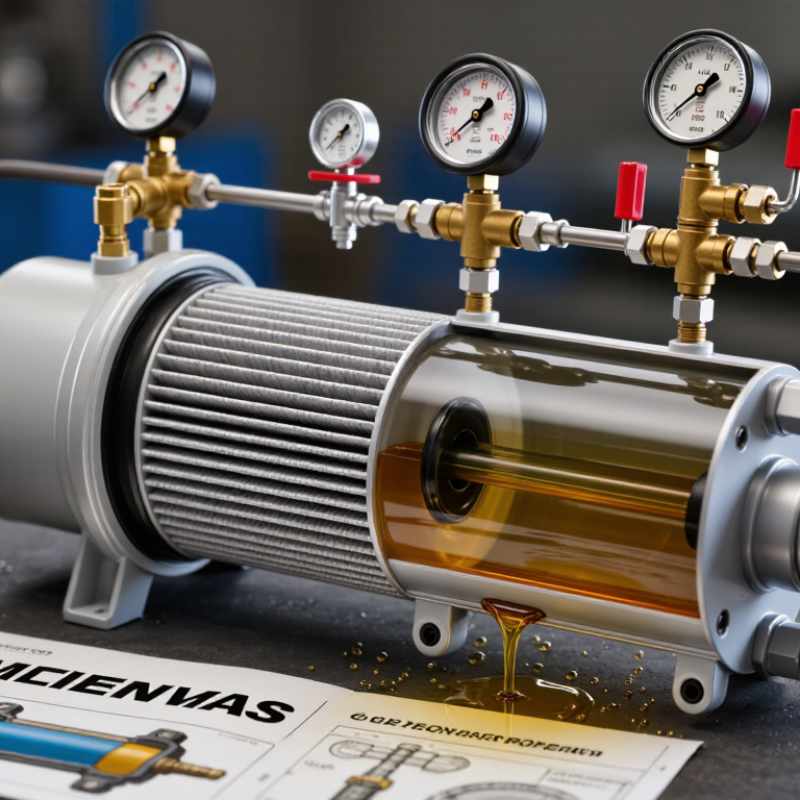
The element works as oil passes through its filtering media. The media captures particles on its surface or within its depth. As contamination builds, pressure drop across the element increases. A pressure indicator can reveal this change before performance declines. Some housings include a bypass valve, which opens when resistance becomes excessive. Bypass flow protects the system from starvation, but it also allows unfiltered oil through. That is not a normal operating condition.
Choosing an element requires more than matching thread size. Check the required flow rate, operating pressure, oil viscosity, temperature, and housing dimensions. Select a suitable filtration rating for the most sensitive component. Absolute ratings usually provide more meaningful control than vague “fine filter” descriptions. Element materials must also resist the hydraulic fluid and expected temperature range. I once treated a filter as a simple replacement part, and that assumption caused an avoidable pressure problem. The element’s capacity, seal quality, and collapse strength deserve equal attention. A perfect choice on paper may still fail if maintenance records are poor.
Identify the Correct Filter Type for Your Hydraulic System
Choosing a hydraulic filter begins with identifying where contamination must be controlled. A suction strainer protects the pump from large particles, but it is not a precision filter. A pressure-line filter handles high pressure near sensitive valves and actuators. A return-line filter cleans oil before it re-enters the reservoir. Each location demands a different housing, bypass setting, and flow capacity.
Use measured system data, not guesswork. Record maximum pressure, normal flow, oil viscosity, temperature, and the target cleanliness code. ISO 4406:2021 converts particle counts into a three-number code. For example, code 22 includes more than 20,000 particles of at least 4 microns per millilitre. That figure can expose an overlooked contamination problem. It is not merely paperwork.
Check the filter’s beta ratio under ISO 16889:2021 multi-pass testing. A high beta ratio indicates stronger particle removal, but it does not guarantee long service life. Dirt-holding capacity matters. So does pressure drop. In field maintenance, I have seen operators select a fine element while ignoring cold-oil viscosity. The element then bypassed during startup. Poor choice. Match the filter rating to the cleanest required component, then confirm actual cleanliness with particle-count reports. Portable monitoring helps, although sampling errors remain common. Use clean bottles, correct sampling points, and repeat tests before changing the filter type.
How to Choose the Right Hydraulic Oil Filter Element?
Identify the correct filter type by matching the installation location with the required nominal particle rating.
The values represent common engineering selection points: suction strainers are typically coarse to protect the pump from large contaminants, while return-line, pressure-line, and offline filters generally use finer elements. Actual requirements depend on component cleanliness codes, fluid viscosity, flow rate, pressure, and the hydraulic system manufacturer’s specifications.
Match Filtration Efficiency, Micron Rating, and Dirt-Holding Capacity
How to Choose the Right Hydraulic Oil Filter Element?
Choosing a hydraulic oil filter element starts with the system’s real contamination risk. A clean workshop does not guarantee clean fluid. Dust can enter through reservoir breathers, seals, and open service ports. Check the required filtration efficiency at the target micron rating. A “10-micron” element may describe nominal performance, not absolute performance. These ratings are not interchangeable.
Look for beta ratios tested under ISO 16889 conditions. A higher beta value indicates better particle removal at a specific size. For example, β10 = 200 means the element captures most particles around 10 microns. However, efficiency alone can mislead. A highly efficient element with low dirt-holding capacity may clog quickly. Monitor pressure drop during cold starts and normal operating temperature. Small details matter.
Dirt-holding capacity shows how much contamination the element can retain before restriction becomes excessive. Compare test data under similar conditions, not isolated numbers. Oil viscosity, flow rate, and particle type can change the result. I once selected a filter by micron rating alone. It worked briefly, then restricted earlier than expected. That mistake reinforced a practical rule: match efficiency, micron rating, and capacity together. Leave reasonable margin for dirty environments and maintenance delays. Perfect calculations are rare. Real systems are less tidy.
How to Choose the Right Hydraulic Oil Filter Element? — Match Filtration Efficiency, Micron Rating, and Dirt-Holding Capacity | Hydraulic Circuit / Application | Typical Cleanliness Target
(ISO 4406) | Recommended Filter Rating
(Absolute, µm) | Minimum Performance Indicator
(Beta Ratio) | Approximate Particle Removal Efficiency | Typical Dirt-Holding Capacity Range* | Selection Rationale |
| High-pressure servo and proportional valve protection | 15/13/10 to 16/14/11 | 3–6 µm | β6(c) ≥ 1,000
or equivalent | ≥ 99.90% at the stated test particle size | Approximately 50–150 g | Fine filtration helps protect narrow valve clearances and reduce contamination-related sticking. Confirm that the element can withstand the system pressure and pressure surges. |
| General pressure-line filtration | 16/14/11 to 18/16/13 | 6–10 µm | β10(c) ≥ 1,000 | ≥ 99.90% at 10 µm | Approximately 80–250 g | A balanced choice for pumps, directional valves, and actuators when clean oil is required without the pressure drop of an ultra-fine element. |
| Return-line filtration | 17/15/12 to 19/17/14 | 10–25 µm | β10(c) ≥ 200
or β20(c) ≥ 1,000 | ≥ 99.50% at 10 µm
or ≥ 99.90% at 20 µm | Approximately 100–350 g | Captures wear particles before fluid returns to the reservoir. Select higher dirt-holding capacity when the system has a large reservoir, frequent cycling, or a high contamination load. |
| Off-line kidney-loop or polishing filtration | 14/12/9 to 16/14/11 | 3–10 µm | β6(c) ≥ 1,000
or β10(c) ≥ 1,000 | ≥ 99.90% at the rated particle size | Approximately 50–300 g | Suitable for continuously improving reservoir cleanliness. Use a high-efficiency element with adequate flow capacity and monitor pressure drop during service. |
| Industrial hydraulic power unit with moderate contamination | 18/16/13 to 20/18/15 | 10–25 µm | β20(c) ≥ 200 | ≥ 99.50% at 20 µm | Approximately 150–400 g | Provides practical protection for conventional pumps and valves while offering a relatively high contaminant-holding capacity. |
| Suction-line protection | Usually not the primary cleanliness-control location | 75–150 µm | β75(c) ≥ 2
or manufacturer-defined coarse rating | ≥ 50% at 75 µm when β = 2 | Approximately 25–150 g | Use a coarse, low-restriction strainer to protect the pump from large particles. Excessive suction restriction can cause cavitation, so fine filtration is generally avoided here. |
| Mobile equipment exposed to dust and high contamination | 18/16/13 to 21/19/16 | 10–25 µm return line;
6–10 µm pressure line | β10(c) ≥ 200
or β20(c) ≥ 1,000 | ≥ 99.50% at 10 µm
or ≥ 99.90% at 20 µm | Approximately 200–500 g | Prioritize dirt-holding capacity and robust element construction when airborne dust, water ingress, and frequent filter loading are expected. |
| *Dirt-holding capacity values are representative comparison ranges, not universal ratings. Actual capacity depends on filter area, media design, test dust, flow rate, fluid viscosity, terminal pressure-drop limit, and test method. Beta ratios should be compared only when they use the same particle-size convention, such as the ISO 16889 “c” calibration. For reference, filtration efficiency is calculated as: Efficiency = (1 − 1/β) × 100%. |
Check Material Compatibility, Pressure Ratings, and Flow Requirements
How to Choose the Right Hydraulic Oil Filter Element?
Selecting a hydraulic oil filter element starts with material compatibility. Check the filter media, seals, and adhesive against the oil type and additives. A seal may appear normal, yet swell after several operating hours. Temperature changes can worsen this problem. I once focused on filtration accuracy and overlooked a seal’s temperature range. That small mistake caused leakage during cold startup. Review the fluid data sheet and filter manufacturer’s compatibility information before installation.
Pressure ratings must match the system, not just the pump’s normal pressure. Compare the element’s operating pressure, collapse pressure, and differential pressure rating. A clogged element can experience a sharp pressure increase. Cold oil may also create higher resistance. The housing, bypass valve, and element should work together under these conditions. Flow requirements deserve equal attention. Confirm the system’s maximum flow, expected pressure drop, and required filtration efficiency. An element that is too restrictive can reduce actuator speed and generate unnecessary heat.
Tips: Measure actual flow when possible, rather than relying only on catalog values. Inspect the used element for metal particles, fiber damage, or uneven dirt loading. These details often reveal installation problems or abnormal wear. Recheck your selection after changing oil viscosity or operating temperature. A choice that works in a clean test may perform differently in a dusty workshop. Never ignore that possibility.
Evaluate Installation, Maintenance Needs, and Replacement Quality
Choosing a hydraulic oil filter element starts with the installation environment, not the catalog number. Check fluid viscosity, operating temperature, flow direction, and housing pressure rating. A filter rated for 250 bar may still fail if pressure spikes exceed its collapse rating. During installation, keep the element sealed until use. Wipe the housing carefully, lubricate the gasket with compatible oil, and tighten it evenly. Small dirt particles can enter through an open port. They are easy to miss.
Maintenance should follow evidence, not habit. ISO 4406 cleanliness codes help compare fluid samples, while ISO 16889 multipass testing provides a technical basis for filtration performance. Industry training reports often associate 70–80% of hydraulic failures with contamination, although the exact percentage varies by system and reporting method. That uncertainty deserves attention. Use differential-pressure readings, particle counts, and temperature trends to set replacement intervals. A calendar-only schedule is convenient, but often inaccurate. Replace the element when restriction rises, contamination persists, or the media shows damage. Select replacement quality through verified beta ratios, burst strength, seal compatibility, and traceable test records. A low-cost element may fit perfectly yet load quickly, shed fibers, or open its bypass valve too soon. Ask for test evidence, not attractive packaging. After replacement, inspect the old media. Shiny metal, rubber fragments, or dark varnish can reveal a deeper fault. The filter may be the messenger, not the cause.
